How Canadian EMS Chooses CPR Training Manikins for Skill Mastery
Paramedics, firefighters, and community first responders in Canada carry a quiet burden. They must be ready to deliver perfect compressions on a kitchen floor in Moose Jaw, pivot to pit-crew CPR at a Toronto high-rise, and coach a bystander through an AED in a curling rink where the ambient temperature hovers near freezing. The manikins they train on decide how well these skills embed. Over years of outfitting services, teaching instructor cohorts, and hauling gear through airports in January, I have seen how the right choice of CPR training manikins raises competence and confidence, and how the wrong choice wastes hours and budget.
This is not about brands so much as it is about fit for task. Canadian EMS agencies purchase in cycles, usually tied to training initiatives, protocol updates, or a new class of recruits. Decisions balance realism, portability, data capture, and the unglamorous details like whether lung bags are in stock and who will disinfect 30 torsos after a night shift. Here is how those decisions get made by teams who live with the equipment.
What skill mastery looks like in a Canadian EMS context
High quality CPR is measurable. Adults require a compression depth of about 5 to 6 cm, a rate of 100 to 120 per minute, full chest recoil, and minimal pauses. When an advanced airway is in place, ventilations drop to roughly 10 breaths per minute with continuous compressions. Those facts are universal. The Canadian context adds a few twists that shape manikin selection.
Training often runs in bilingual classrooms, travels to remote and northern communities, and hops between municipal stations that see dozens of students a week. Instructors need to shift between lay rescuer courses one day and paramedic recertification the next, sometimes in borrowed church basements, sometimes in clinical simulation labs. The same set of torsos might teach 30:2 compressions for public courses and airway management with bag-valve-mask for advanced teams. If the budget allows only one platform, it has to do both reasonably well.
The other reality is weather and logistics. Trucks in Alberta and Ontario roll with cases that handle salt, slush, and road grit. In Nunavut, gear rides in aircraft holds and sleds. Foam and plastics that look fine in product photos can crack at minus 20 if left in a vehicle overnight. Agencies that think through these details train more consistently and spend less on replacements.
Defining the requirements before the shopping begins
I encourage training leads to write a one-page requirement list before ever looking at brochures. The exercise forces clarity. Most projects boil down to four pillars: instructional goals, environment, throughput, and data.
Instructional goals drive features. If the objective is mastery of compression quality for Basic Life Support, optical or mechanical feedback that shows rate, depth, and recoil tends to correlate with better performance. If the objective includes airway adjuncts or supraglottic device placement, you need a different anatomy and replaceable airways. For AED integration, pad placement landmarks and torso size matter more than advanced airway features.
Environment shapes durability and portability. Instructors who travel by air prefer torsos under 4 kg with a compact case. Rural programs that teach in community centers may need robust skins that tolerate frequent disinfecting and hundreds of setups. Services that use outdoor or cold venues should ask about material performance across temperature ranges. Portability is not just weight, it is how parts stow so nothing is lost in dark parking lots.
Throughput means how many learners and how quickly. Municipal services often certify crews quarterly, running 12 to 18 participants per day. Feedback-enabled manikins reduce instructor bandwidth, allowing more stations running in parallel. But feedback can slow turnover if devices require pairing and updates. The sweet spot is manikins that show compressions in real time without a fragile app layer, while still offering Bluetooth connectivity for data capture when needed.
Data closes the loop. Heart and Stroke courses and many EMS QA programs now ask for objective metrics. A platform that logs compression fraction, average rate, and depth provides defensible sign-offs. It also lets coordinators show improvement over time to administrators and medical directors, strengthening support for training budgets.
The feature set that matters, in practice
Marketing copy often lists features that sound similar. On the ground, a few characteristics create the most value.
Feedback that you can see at a glance. Lighted indicators for rate and depth help a student self-correct without waiting for coaching. Mechanical clickers are better than nothing, but they teach rate more than depth, and they do not measure recoil reliably. Optical systems tethered to a mobile app are excellent in small groups, less so when 24 students share four torsos and a single instructor.
Realistic chest recoil and resistance. Newer foam composites and spring mechanisms give a closer feel to an adult sternum. If the resistance is too light, strong providers learn to under-compress on patients. If it is too stiff, smaller rescuers lose form. Good designs offer adjustable spring settings or a standard that matches guideline targets within a tolerable variance.
Airway realism, with judgment. There is a gulf between basic CPR torsos and advanced intubation heads. For EMS recertification focused on compressions, ventilation with BVM, and AED use, a basic manikin with an open airway and nose-to-mouth seal works. If your protocols include supraglottic devices for primary airway, a manikin that accommodates insertion and bagging without damage bridges the gap. Full intubation heads are valuable for dedicated airway labs, but as all-in-one solutions they add cost and fragility.
Pad placement, torso size, and defibrillation training. AED trainer pads need to adhere and release dozens of times in a session. Smooth plastics shed adhesive over time. A textured chest or replaceable skin prolongs pad life. Torso size matters when agencies train on two-person CPR in cramped spaces, such as washrooms or stairwells. For pediatric practice, separate child and infant models pay off, even if some adult torsos accept pediatric pads.
Hygiene and maintenance. After 2020, no one overlooks cleaning. Removable face pieces, single-use airways, and non-porous skins speed turnaround. Alcohol tolerance varies by material. Check manufacturer cleaning guidance for compatibility with common Canadian disinfectants used by your agency, not just generic wipes. Lung bag and face shield costs, multiplied by student volume, often exceed the price delta between brands within a year.
Connectivity and software. Many feedback systems now sync to an app that records metrics. In theory, this is ideal for audits, remediation, and quality improvement. In practice, multiple Bluetooth sessions in one room, across Mixed OS tablets, can tax an instructor. Look for platforms that let you run without pairing, then bulk-download a summary when class wraps. Bilingual interfaces and printable certificates also matter in Canadian programs that span English and French.
Matching the manikin to course portfolios
Most Canadian EMS training divisions run multiple streams. Community CPR for the public, BLS for healthcare providers, and paramedic-specific refreshers share resources. Pairing the right manikin to each stream raises ROI.
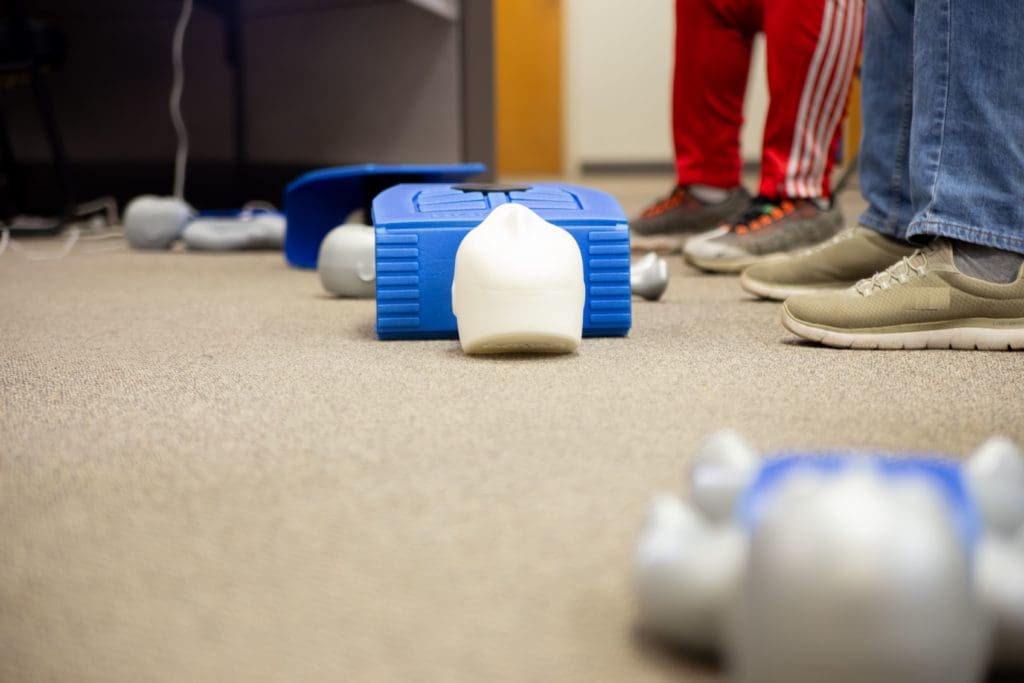
Community CPR and AED courses depend more on simplicity and pad placement cues. Lightweight torsos with visible feedback rings, molded landmarks, and easy-launder airways work well. Since these classes often rotate through workplaces, schools, and arenas, portability and ruggedness beat high-fidelity lungs. Instructors appreciate torsos that set up in under two minutes per unit. When integrating AED training equipment Canada wide, ensure the AED trainers accept bilingual voice prompts and have universal pad connectors for replacement ease.
BLS for healthcare providers needs crisp compression metrics and basic ventilation practice with pocket masks or BVM. A torso with visual indicators for rate, depth, and recoil, along with an airway that accepts a two-person BVM seal, hits the mark. Pediatric practice is not optional. Separate child and infant manikins that replicate chest wall compliance teach hand placement and gentle recoil control, which does not translate from adult torsos.
Paramedic recertification adds team choreography and pit-crew roles. Here, feedback that a team leader can see across a room drives performance. Larger torsos with tablet dashboards help for debriefs, but they must continue to function if the tablet dies mid-scenario. If advanced airways are on the docket, set up a dedicated head or airway trainer on a separate station rather than forcing a single torso to do everything poorly.
Canadian procurement realities that shape selection
Budgets vary widely. A small rural service may outfit two crews with a pair of adult torsos, one child, one infant, and a single AED trainer. A large metropolitan service might procure 30 feedback-enabled torsos, multiple pediatric sets, high-fidelity simulators for paramedic school partnerships, and a library of spare parts. The patterns below recur regardless of scale.
Pricing ranges give a sense check. Entry-level torsos suitable for community training typically run a few hundred dollars each. Feedback-enabled adult torsos often land in the 700 to 1,500 dollar range per unit, with pediatric units somewhat less. AED trainers usually sit around 300 to 600 dollars each depending on features and language options. High-fidelity simulation torsos for advanced airway, perfusion, and monitor integration start in the low thousands and scale past five figures. Consumables, such as lung bags and faces, can run 2 to 6 dollars per learner per session and deserve a line item of their own.
Parts and service access across provinces matter more than sticker price. A warranty is only as good as the Canadian distributor’s inventory. Ask whether common parts are stocked domestically, how long RMA turnaround takes, and whether you can buy CPR instructor packages Canada side that bundle spares, lung bags, and carry cases. I have seen courses cancelled because replacement valves sat in a customs queue. A vendor with a Calgary or Toronto warehouse avoids those bottlenecks.
Bilingual packaging and documentation save time. Labels, cleaning instructions, and app interfaces should be available in English and French. This is a procurement box to tick for many public agencies. It also reduces instructor friction when teaching in Quebec or federal workplaces.
Electrical approvals and safety. While CPR training manikins are generally non-therapeutic devices and not Health Canada regulated like patient monitors, any powered or charging accessories should meet Canadian electrical safety requirements. Chargers that ship with North American plugs and have CSA or equivalent approval avoid headaches with agency safety officers.
Logistics and Medical simulation equipment Canada travel. Pelican or comparable hard cases live longer on Canadian roads and tarmacs. Foam inserts cut to the manikin’s shape keep everything together in the back of a rig. If cases are not included, budget them and check airline CPR supplier and service Canada size and weight limits. After two winters of lifting manikins out of soggy cardboard, most teams never go back.
The AED training piece is not an afterthought
Survival depends not just on compressions but rapid defibrillation. Manikin selection should anticipate how AED training equipment Canada wide integrates with classes. Mixed-fleet AED environments are common. Police services might carry one brand, fire another, with public access devices in town halls and arenas from a third manufacturer. Students should practice pad placement on torsos that clearly demarcate sternal notch, mid-axillary line, and lower ribcage, with skins that tolerate dozens of pad cycles in a session.
AED trainers should mirror the button layout, prompts, and analysis behavior of local devices. Bilingual voice prompts help when classes include French-speaking participants or take place in Quebec and New Brunswick. Some manikins support internal pad placement guides that light up when correct. This can speed lay rescuer classes. For EMS teams, I prefer manikins that force the student to rely on landmarks, then use debriefs to correct pad drift.
Hygiene protocols build credibility
Early in the pandemic, instructors spent half their day disinfecting. Although protocols have eased, perception and trust linger. Students notice whether manikins look clean, whether faces are swapped between learners, and how instructors manage shared airways. Programs that codify simple, visible hygiene steps ease concerns and reduce absenteeism.
A workable routine is to assign each student a face shield or valve, clean the manikin face between users, and bag consumables per learner. Instructors wear gloves when swapping parts, and bins are clearly labeled for clean and used items. Choose torso skins that withstand the disinfectants you already stock for ambulances and stations. The cost uptick of consumables pays for itself in time saved and participant comfort. CPR and first aid training kits that align with your cleaning protocol, down to labeled zip pouches and trash points, make the room run smoother.
One platform rarely fits all
The temptation to buy a single model for every course is strong. Consistency helps with parts and training scripts. But edge cases sneak in. Bariatric patient simulations require a wider chest. Pediatric arrests demand a specific hand feel that no insert replicates. Airway teams deserve heads that accept the devices they will actually deploy without damaging seals.
In mixed portfolios, I like a tiered approach. Equip the bulk of stations with robust feedback-enabled adult torsos. Add a small cadre of pediatric units that stay paired as a set. For airway skills, stock dedicated heads that do not leave the sim lab unless needed. Finally, keep a few lightweight adult torsos for outreach and travel. This approach still lets you buy CPR instructor packages Canada wide for discounts, while avoiding over-reliance on one fragile feature set.
Training in cold rinks, warm gyms, and tiny rooms
Canadian instructors tell stories of classes in hockey arenas, mine sites, curling clubs, and cramped condo party rooms. Manikins behave differently across these spaces. Cold plastic stiffens. Adhesives lose tack. Bluetooth range changes. A program that tests equipment in these real venues before committing to large buys avoids surprises.
In rinks, AED pads release early unless you warm the torso skin first. A quick fix is to store torsos indoors and bring them out just before scenarios. In hot gyms, sweat and dust clog clickers. Choose optical or magnetic sensors in those environments. In tight spaces, a smaller torso footprint helps teams practice realistic compressions and rotations without the artificial clearance of a lab.
Instructor bandwidth is the hidden constraint
A classroom lives or dies by instructor energy. Feedback manikins promise autonomy, but someone must reset devices, interpret dashboards, and coax quiet learners into practicing more. If software onboarding takes an hour before each class, it will not be used. Manikins with simple, visible feedback let one instructor float across multiple stations and catch errors early. When the team is larger or dedicated, advanced dashboards pay off in data for debriefs and QA.
Training divisions also change hands. When a seasoned coordinator retires, the new lead inherits what is on the shelf. Choose platforms with good documentation, quick-start cards, and video libraries. Stock spares that match what instructors are used to. If your agency hires external instructors for public courses, align your CPR and first aid training kits with their habits, right down to how faces are stored and which wipes they use.
A short checklist for buyers weighing options
- Clarify your top two training outcomes for the next 18 months, and buy for those, not for someday.
- Verify parts, consumables, and warranty support are stocked in Canada with realistic delivery times.
- Test feedback visibility in a full room, with the tablet off, and confirm metrics still display.
- Validate cleaning protocols with your current disinfectants and run a timed turnaround between users.
- Dry-run AED pad placement on the chosen torso using your actual trainer pads in a cold and warm room.
Where the budget hides and where to invest
The upfront cost attracts executive attention, but three stealth costs often upend plans. First, consumables eat capital if you train thousands per year. A switch to reusable valves reduces spend, but only if cleaning protocols and time exist. Second, shipping and case costs add up, especially for remote programs. Budget for rugged transport from the start. Third, instructor time is a currency. A platform that halves coaching time per learner pays for itself over a few cohorts.
Invest where learning sticks. Feedback on depth, rate, and recoil is not a luxury if resuscitation is core to your mission. Pediatric manikins deserve a line item even in adult-focused services because pediatric arrests, though rare, carry high stakes and unique mechanics. AED trainers that mirror local devices reduce hesitancy during real calls. Finally, data capture that integrates with your QA process turns classes into improvement programs instead of one-off checkboxes.
Tying equipment to performance improvement
Equipment alone does not lift survival rates. It has to plug into practice. The best Canadian EMS programs build a cadence. Crews run short, focused drills during shifts, log key metrics monthly, and rotate instructors to keep eyes fresh. Manikins that record compression fraction and accuracy feed dashboards that training officers use for targeted refreshers. Over a year, the curve bends. Pauses shorten, compression quality rises, and AED deployment speeds up.
This works at community scale too. Municipal services that equip recreation centers with layperson-friendly CPR training manikins Canada wide see volunteer coaches running evening refreshers without formal classes. When public and professional responders train on similar platforms, the handoff in real events feels familiar. That familiarity is worth more than another accessory head.
Integrating with broader emergency training equipment
CPR does not happen in a vacuum. Alongside manikins, agencies stock AED training equipment Canada wide, oxygen kits, splints, and trauma gear. Choosing a manikin that coexists with these tools lets instructors run full scenarios. For example, torsos that tolerate compressions on floors with backboards in place, or that fit on stretchers without sliding, create realistic choreography. Lights and sounds from AED trainers should not drown out team communication, especially in bilingual environments where prompts double.
For multi-skill days, pack CPR and first aid training kits that align with manikin features. If the manikin accepts BVM, include appropriately sized masks and reservoirs. If scenarios include choking, make sure abdominal thrust trainers are on hand so no one practices on live partners. Consistency across kits also reduces packing errors when classes move between venues.
Examples from the field
A mid-sized Ontario service replaced decade-old torsos with feedback-enabled units and added two infant manikins per platoon. They did not change their curriculum, only the feedback and the emphasis on recoil. Over three quarters, they saw compression depth within target improve by 20 to 30 percentage points in competency checks, and average hands-off time dropped during mock codes as team leads used the lights to coach.
A northern training program serving fly-in communities needed rugged, light gear that fit in small aircraft. They chose compact torsos with removable faces, skipped app-dependence, and invested instead in hard cases and spare consumables. Classes ran in school gyms and community halls where cellular service was spotty. Equipment survived, and classes stayed on schedule because nothing depended on a tablet update.
A Quebec fire department switched AED trainers to bilingual models and aligned pad shape and cable direction with their field devices. Complaints about confusing prompts vanished, and during a mall arrest a bystander who had attended a community class recognized the same voice, placed pads correctly, and delivered the first shock before crews arrived.
Final thoughts from long days in the classroom
I have hauled manikins up three flights of stairs in February, fumbled with dead tablets, and wiped down faces past midnight after an overtime class. The gear that earns its keep shares a few traits. It tells the truth about compressions without fuss, it tolerates being tossed into a truck and used on dusty floors, and it is supported by people who answer the phone when a part cracks before a big course. The rest is bonus.
For Canadian EMS agencies and training partners, that means prioritizing clear feedback, reliable parts supply inside Canada, bilingual usability, and a mix of adult, child, and infant options. Align choices with your real teaching environments, not a glossy lab. Fold AED training equipment into the plan from the start, and choose CPR instructor packages Canada wide that make logistics less of a grind. When equipment, instructors, and context line up, the skills that matter most become second nature, and that shows where it counts.